I have sat across from business owners who were thrilled with their ad campaign.
“Look at the reach — over two lakh people!” “The engagement is amazing — so many likes and comments.”
And then, quietly: “But the sales numbers have not really moved.”
This is what happens when you measure the wrong things. Digital advertising platforms give you a flood of data. Impressions, reach, clicks, click-through rate, engagement rate, video views, frequency, cost per click. All of these are real numbers. Some are useful. Some are noise. And the ones that actually tell you if your advertising is working are often the ones people look at last.
The metric hierarchy
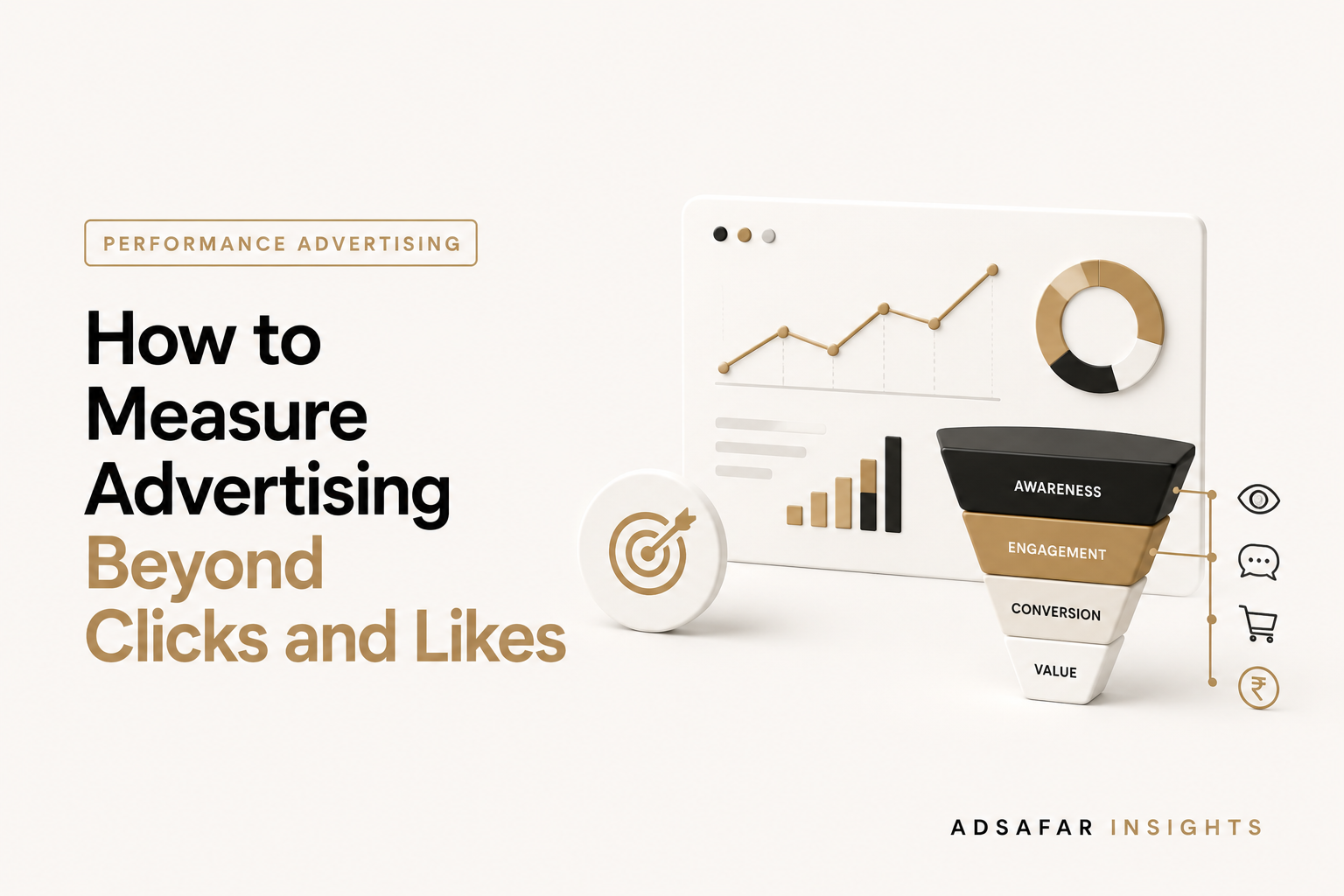
Every advertising metric falls into one of three levels.
Attention metrics
Did people notice your ad? Impressions, reach, video views, frequency.
Interest metrics
Did people engage with it? Clicks, click-through rate, comments, shares.
Action metrics
Did people do what you wanted? Leads, purchases, calls, form fills, bookings.
The only metric that pays
The only metric that pays for itself is action. Attention and interest are necessary steps, not outcomes.
The metrics that actually matter
Cost Per Lead
How much does it cost you on average to get one person to raise their hand and say they are interested? If your cost per lead is 150 rupees and you convert one in five leads to a customer, you are spending 750 rupees to acquire a customer. If your customer’s average purchase value is 5,000 rupees, that is a healthy ratio. If it is 500 rupees, you have a problem. Cost per lead tells you how efficiently your campaign is generating pipeline.
Cost Per Acquisition
How much does it cost to acquire one paying customer? This is the metric that matters most for businesses with direct sales. It requires conversion tracking to measure accurately. But once you have it, it tells you clearly whether your advertising is profitable or not.
Return on Ad Spend
For every rupee you spend on advertising, how many rupees of revenue does it generate? A ROAS of 3 means you are earning 3 rupees for every 1 rupee spent on ads. A ROAS of 1 means you are breaking even. The minimum viable ROAS depends on your margins. A high-margin business can be profitable at 2x. A low-margin business might need 6x or more to remain profitable after costs.
Lead quality, not just quantity
Ten low-quality leads from people who were never really interested are worth less than two highly qualified leads from people who are ready to buy. Track not just how many leads you got but how many of them converted and at what rate. If your ad is generating a lot of leads that never go anywhere, the problem might be in your targeting or your offer, not your follow-up process.
Metrics you can mostly ignore
Reach and impressions tell you how many people saw your ad. They do not tell you if those people were the right people or whether the ad led to anything meaningful. Reaching two lakh people who were never going to buy is worth less than reaching two thousand people who were perfectly targeted.
Likes and comments can mean the ad is relatable and creative. They do not mean it is generating business. Many highly engaging ads generate lots of attention and very few conversions.
Cost per click without context is also misleading. A low cost per click feels efficient. But if those clicks are not converting, low cost per click just means you are failing cheaply.
The report you review each month should answer one question above all others: did this advertising produce business outcomes, and at what cost?
If you are working with a digital advertising agency, the report you review each month should include at minimum: total ad spend, number of leads or conversions generated, cost per lead or cost per acquisition, conversion rate showing how many leads became customers, and comparison to the previous period. If an agency is only showing you reach, impressions, and engagement without connecting to business outcomes, ask them to add the outcome metrics. If they cannot, that is a conversation worth having.
Measuring ads the right way
- Reach and impressions are attention metrics. They are not outcomes.
- Cost per lead and cost per acquisition are the metrics that connect advertising to business results.
- ROAS tells you whether your advertising is profitable relative to your margins.
- Lead quality matters as much as lead quantity. Track conversion rates, not just volume.
- A good monthly report shows business outcomes, not just platform performance metrics.
For most businesses, cost per acquisition — what you spend to gain one paying customer — is the most meaningful metric. It directly connects advertising spend to business outcomes rather than platform activity.
There is no universal benchmark. For e-commerce businesses, a ROAS above 3x is generally considered a good starting point. For service businesses, the math is different. Focus on cost per lead and lead-to-sale conversion rate instead of ROAS alone.
They are context, not outcomes. Reach and impressions tell you how many people saw your ad. They do not tell you if those people were the right people or whether the ad led to anything meaningful for your business.
Ask for a report that includes leads generated, cost per lead, conversions, and revenue or enquiry value. If the report focuses primarily on reach, impressions, and engagement without connecting to business outcomes, ask them to include the outcome metrics in every future report.