Open Google Maps in any Indian city and search for “digital marketing agency.” Or “interior designer.” Or “coaching institute.” Or “jewellery store.”
You will find dozens of results. Maybe hundreds.
Now visit five of their websites.
You will notice something uncomfortable. They are nearly identical. Same claims. Same language. Same stock photos. Same vague promises of quality and expertise and customer satisfaction.
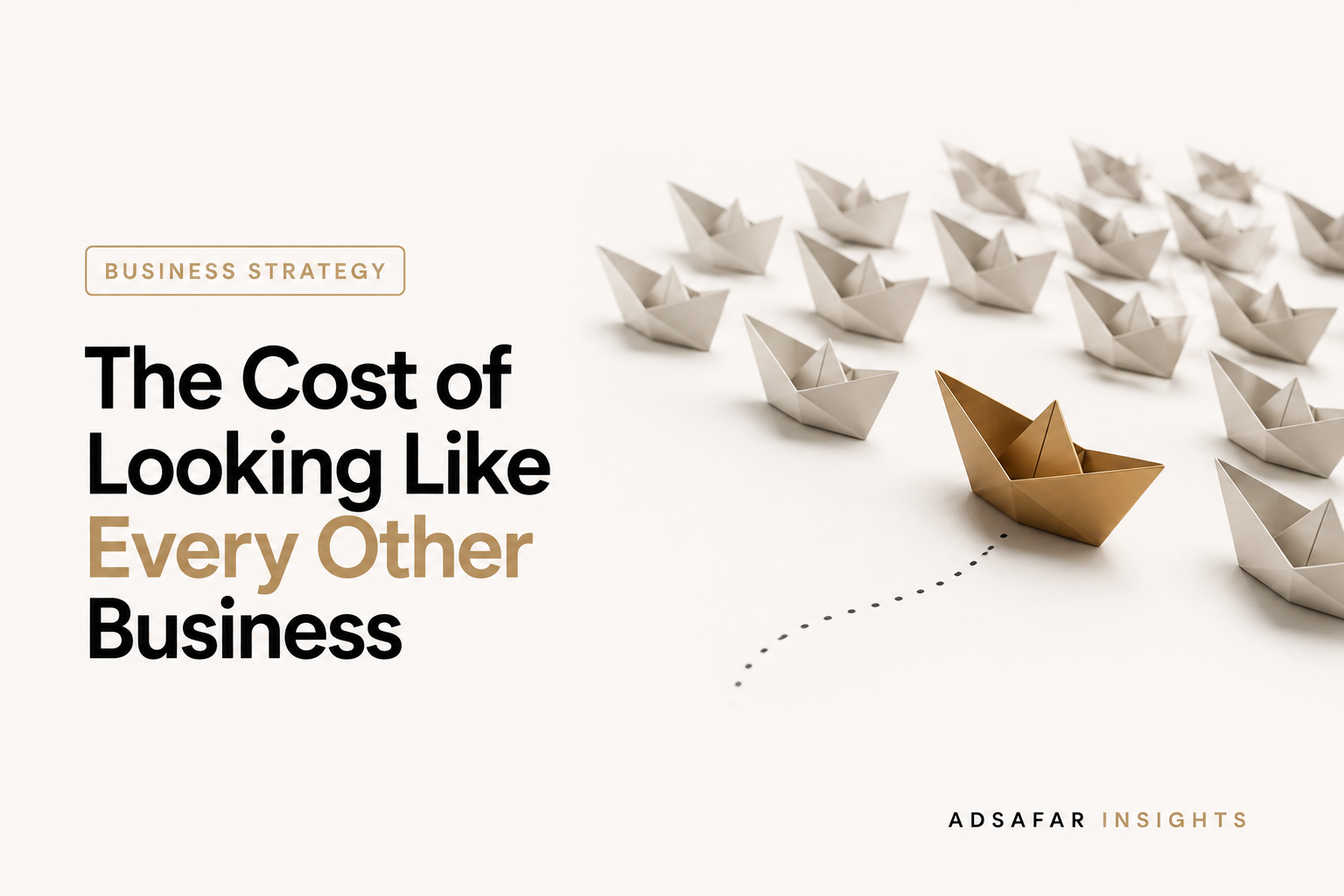
Every business thinks it is different. Almost none of them look different.
And this invisibility has a real cost — one that most business owners attribute to the wrong cause.
What invisibility actually costs you
When your business looks and sounds like every other option in the market, the customer’s only basis for a decision is price.
If you are the cheapest, you win. Until someone goes cheaper.
This is the commodity trap, and it is one of the most common reasons businesses struggle to grow even when they are genuinely good at what they do. It looks like this:
- Enquiries come in but conversion rates are low
- Customers who do buy are highly price-sensitive
- No one refers you unless you are the cheapest option
- You keep having to prove your value from scratch with every new prospect
None of this is because you are not good enough. It is because your business has not given the market a reason to see you as distinctly different.
Price alone will not save you. Someone can always go cheaper. Quality alone will not save you. Customers cannot tell the difference without experiencing you first. What saves you is distinctiveness.
Why “quality” and “service” are not differentiators
The most common response to “what makes you different?” from Indian business owners:
“Our quality is very good.” “We give excellent service.” “We care about our customers.”
Every competitor says exactly the same thing.
These are not differentiators. They are table stakes — the minimum the customer expects before they will consider you at all. They do not answer the actual question: why you and not the business down the road?
True differentiation is specific, not general. It is something the customer can feel, remember, and repeat when recommending you to someone else.
What genuine differentiation actually looks like
Specialisation is differentiation
A gym that caters exclusively to women over 40 is more distinctive than a gym for everyone. A CA who specialises in tax planning for small manufacturers stands out in a field of generalists. Narrowing your audience is a form of differentiation, not a limitation.
Process is differentiation
How you do something can be as distinctive as what you do. A same-day delivery promise. A 15-minute response guarantee. A transparent pricing model in an industry known for hidden costs. These are process differentiators that customers remember and actively choose.
Personality is differentiation
The way your business communicates — your tone, your directness, the way you handle problems — is something competitors cannot copy directly. It belongs to you. In markets full of formal and generic communication, a business that talks like a real human being can stand out simply by being itself.
Origin is differentiation
Your story is yours alone. Why you started. What you have seen that others have not. The problem you set out to solve. This narrative context makes you a person or a team, not just another vendor in a list of options.
The practical test
Here is a useful exercise. Take your current marketing materials — your website, your Instagram bio, your sales pitch. Remove your business name and logo.
Now ask: could this be any other business in your category?
If the answer is yes, you have found your problem.
The goal is for your communication to be unmistakably yours. That even without a logo, someone familiar with your category would recognise your business from the substance of what you say and how you say it.
How to find what makes you different
You do not need to rebuild your business to differentiate it. You need to identify what is already true and communicate it more clearly.
Start by asking your existing customers, especially the ones who stuck around and refer others, why they chose you and why they stayed. Their answers will often tell you your real differentiator far more clearly than any internal strategy session ever will.
Then say that thing, loudly and consistently.
Write down in one sentence what makes your business different. Not “quality” or “service.” Something specific that only you can honestly claim. If you cannot write it in one clear sentence, your customers cannot say it either. And if customers cannot say it, they cannot refer you. This is where most marketing problems actually begin.
How to stop looking like every other business
- When you look like everyone else, price becomes the only deciding factor.
- “Quality” and “service” are table stakes, not differentiators.
- Specialisation, process, personality, and origin are all forms of real differentiation.
- Remove your logo from your marketing. If it could belong to any competitor, it needs work.
- Ask your best customers why they chose you. Their answers reveal your real differentiator.
- If you cannot say what makes you different in one sentence, your customers cannot either.
Differentiation means giving potential customers a specific, memorable reason to choose you over competitors. It is the thing about your business that only you can honestly claim — your specialisation, your process, your story, or your approach to the work.
Ask your best existing customers why they chose you and why they stayed. The reasons they give are often more specific and honest than anything you would come up with internally. Look for patterns in their answers and build your positioning around what comes up most consistently.
Price can attract customers, but it is a weak long-term differentiator because someone can always undercut you. The strongest differentiation is based on value, experience, or trust — things competitors cannot match simply by lowering their price.
Because differentiation requires making choices — narrowing your audience, committing to a specific approach, saying no to some opportunities. Most businesses are afraid to be specific because they fear losing customers. In reality, trying to appeal to everyone makes them appeal to no one distinctly.